
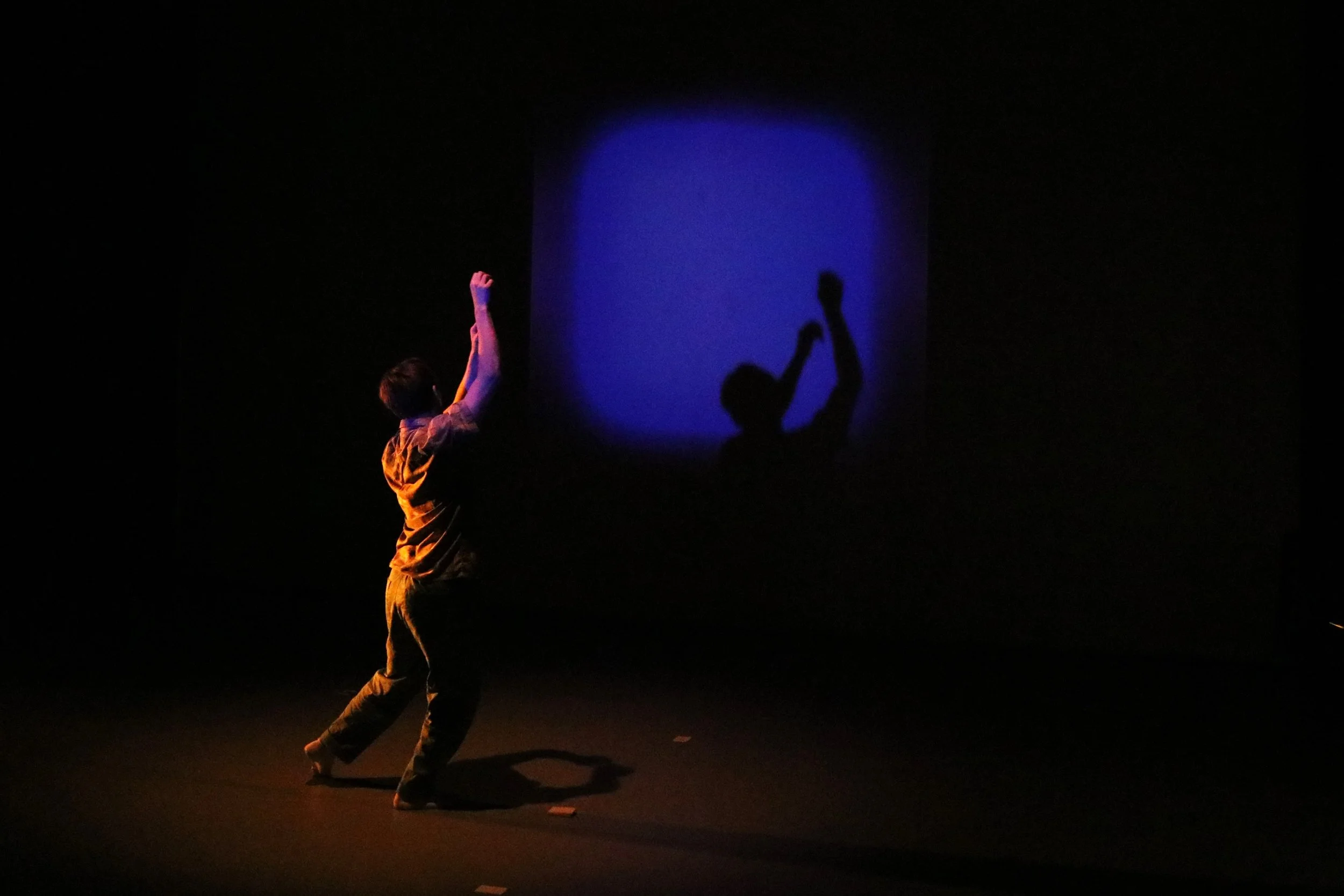
Billy Maxwell Taylor
Winner of our REVERSE PITCH 2025, Billy is an artist working between Wales, the Forest of Dean and East Asia.
“I am deeply interested in how we can curate spaciousness in an increasingly busy and overstimulated world where record numbers of people are facing burnout.
I do this through a practice I call ‘ambient dance’, which affects how I make theatre, choreograph, facilitate dance, create films, take photos and make music.
As well as my work and research across Wales, UK and East Asia, I completed BA studies in European Theatre Arts at Rose Bruford College (2021) and an MA in Expanded Dance Practice at London Contemporary Dance School (2024).
The underpinning concept is that these can all be ways to deepen a soft noticing of the world and induce space to think amidst the crises we face”.

“I am Billy – an interdisciplinary artist based between Wales, the Forest of Dean and East Asia.
I create through a philosophy I call ‘ambient dance’. This draws on contact, dance improvisation and butoh as well as the small dances of everyday life: making coffee, park walks, tending a garden.
I sense the reason I am interested in this more spacious relationship to dance and art is that the world feels quite overstimulating. Slowness is a radical act, as is tenderness and rest. For me, I want to offer space for us to connect to these in a time of burnout.
If I had to sum up my vibe, I’d recommend watching Perfect Days by Wim Wenders. In this, the main character Hirayama shares a short phrase:
今度は今度、今は今 – Next Time is Next Time, Now is Now.
As such, in all my encounters I try to capture this beautiful moment, whether I am making coffee or flipping across a stage. To me, crafting is a way to show deep appreciation for the world and to notice the small dances that underpin our lives.
I also talk a bit in my workshops about the dance of vitality and tranquility. With this, I sense I am searching for a space where we can move our bodies whilst feeling their energy/vitality/qi/life. Yet somehow, our mind also enters a meditative space of noticing. Perhaps we go to the imaginary or perhaps we are with what is in front of us. But we are able to notice it, non-judgementally.
I suppose this is why people often call my approach to making Zen. But then, I don’t really know anything about Zen!”